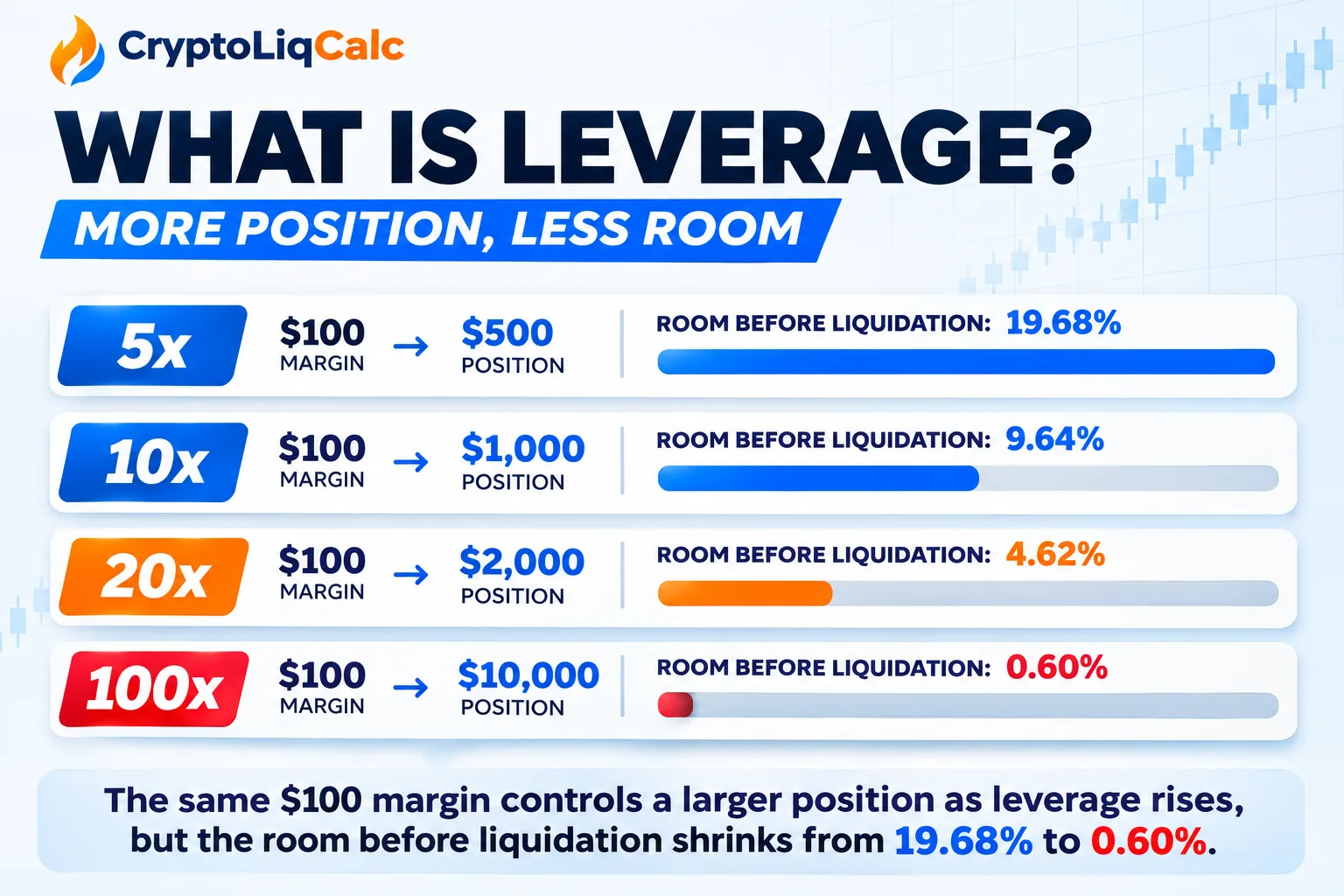
Leverage trading in crypto lets you open a position larger than the margin you put up. With 10x leverage, $100 of margin controls a $1,000 position. That multiplies your gains and your losses, and it moves your liquidation price closer to your entry. This guide shows what 5x, 10x, 20x and 100x mean in dollars and in price distance, and how to choose a level without guessing.
- Leverage is a multiplier on position size. $100 of margin at 10x controls $1,000.
- It multiplies profit and loss equally. At 10x, a 1% price move changes your margin by 10%.
- Higher leverage puts liquidation closer: about 9.64% from entry at 10x, 4.62% at 20x and 0.60% at 100x.
- Pick the stop first, size the position from the loss you accept, then check that liquidation sits beyond the stop. Leverage is what is left.
What leverage trading in crypto means
Leverage is the ratio between your position size and your margin. Margin is the money you set aside to open the trade. If you set aside $100 and open a $1,000 position, your leverage is 10x. In effect the exchange covers the other $900, and in return it can close the position if your losses come close to using up your margin. That forced close is liquidation.
Crypto leverage is a setting you choose on the exchange. It decides how much margin is locked for a given position size. The same $1,000 position needs $200 of margin at 5x, $100 at 10x and $50 at 20x.
The examples below use BTC at $65,000, a long position, isolated margin and a 0.4% maintenance margin rate. If those terms are new, start with how liquidation price is calculated.
What 5x, 10x, 20x and 100x look like
Take $100 of margin. At each leverage level it controls a different position, and the price can move a different distance against you before liquidation.
| Leverage | Position from $100 margin | Liquidation price | Room before liquidation |
|---|---|---|---|
| 5x | $500 | $52,209 | 19.68% |
| 10x | $1,000 | $58,735 | 9.64% |
| 20x | $2,000 | $61,998 | 4.62% |
| 50x | $5,000 | $63,956 | 1.61% |
| 100x | $10,000 | $64,608 | 0.60% |
The liquidation prices come from entry × (1 − 1/leverage) ÷ (1 − 0.4%). You can check any row in the liquidation calculator. They leave out fees, funding and the maintenance margin tiers your exchange applies, so treat them as close estimates.
Leverage multiplies gains and losses equally
The same multiplier works in both directions. With $100 of margin, a 1% move in BTC changes your position value by 1%, which is a much larger share of your margin.
| Leverage | Position | Profit or loss on a 1% move | Change in your margin |
|---|---|---|---|
| 5x | $500 | $5 | 5% |
| 10x | $1,000 | $10 | 10% |
| 20x | $2,000 | $20 | 20% |
| 100x | $10,000 | $100 | 100% |
At 100x, a 1% move against you is the whole margin, so liquidation arrives sooner, at about 0.60% in the example above. Fees and funding come out of the same margin, and they grow with leverage because they are charged on the larger position. Funding rates are worth reading before you hold a leveraged trade for days.
Leverage is not the same as risk
Two people doing crypto trading with leverage can both use 10x and risk very different amounts. What you can lose on a trade is set by the position size and the distance to your stop. Leverage only decides how much margin is locked and where liquidation sits.
This is the order used in the position sizing guide: stop first, then size, then leverage. The position size calculator does the sum for you.
How to choose crypto leverage
- Decide where the trade idea is wrong and place the stop there, before you think about leverage.
- Set the loss you accept as a percentage of your balance and work out the position size from it.
- Choose a leverage whose liquidation price sits well beyond the stop, with a buffer for slippage and fast candles.
- Check the number in the liquidation calculator, then compare it with the figure your exchange shows.
Here is the $65,000 entry with the stop at $64,025, compared at three leverage settings.
| Leverage | Liquidation price | Gap to a stop at $64,025 | Result |
|---|---|---|---|
| 10x | $58,735 | $5,290 below the stop | The stop triggers first, with a wide buffer |
| 50x | $63,956 | $69 below the stop | The stop triggers first, with almost no buffer |
| 100x | $64,608 | $583 above the stop | Liquidation comes first |
At 100x the stop never gets a chance to act. This is one of the causes covered in why you can be liquidated before your stop loss.
What 100x leverage in crypto and 500:1 mean
500:1 and 500x mean the same thing: each $1 of margin controls $500 of position. Margin is 0.2% of the position, so a 0.2% move against you uses it up before fees. You will see that ratio mostly at forex brokers regulated outside the big retail markets, because the UK’s FCA rules cap retail forex at 30:1 on major currency pairs. A few crypto exchanges also list very high leverage on selected contracts. MEXC, for example, promotes 200x on one of its futures contracts.
Crypto exchanges set a maximum leverage for each contract, and it falls as your position grows, as the maintenance margin tiers article shows. On Binance BTC/USDT, the leverage and margin table (checked on 20 November 2026) allows up to 150x for positions up to $300,000 and 100x up to $800,000. Binance also limits new futures accounts to 20x for their first 30 days. Limits differ by exchange and coin and change over time, so read the current figure on your exchange.
At 100x the room before liquidation in our example is 0.60%. That is a small move for Bitcoin. In the 30 days to 20 November 2026, about 4 in 10 one-hour BTC/USDT candles on Binance had a high-to-low range of 0.6% or more, and about 1 in 11 fifteen-minute candles did. A candle’s range is not the same as a one-way move, but it shows that ordinary price noise can reach a 100x liquidation price.
A checklist before you open a leveraged trade
- The stop sits where the trade idea fails.
- The position size comes from the loss you accept.
- The liquidation price is calculated and sits beyond the stop with room to spare.
- Fees and funding are allowed for if you hold the trade for more than a few hours.
- You know your margin mode. Isolated limits the loss to the margin on that position, and cross uses your wallet balance (see isolated vs cross margin).
A sensible leverage setting is usually the lowest one that gives you the position size you worked out. Beyond that point, extra leverage frees margin you may not need and pulls liquidation closer to your entry. This article is educational and is not financial advice.