What Happens After Liquidation in Crypto Futures?
Getting liquidated is stressful, especially the first time. Here's exactly what happens to your account, your funds, and what to do next — no speculation, just the mechanics.
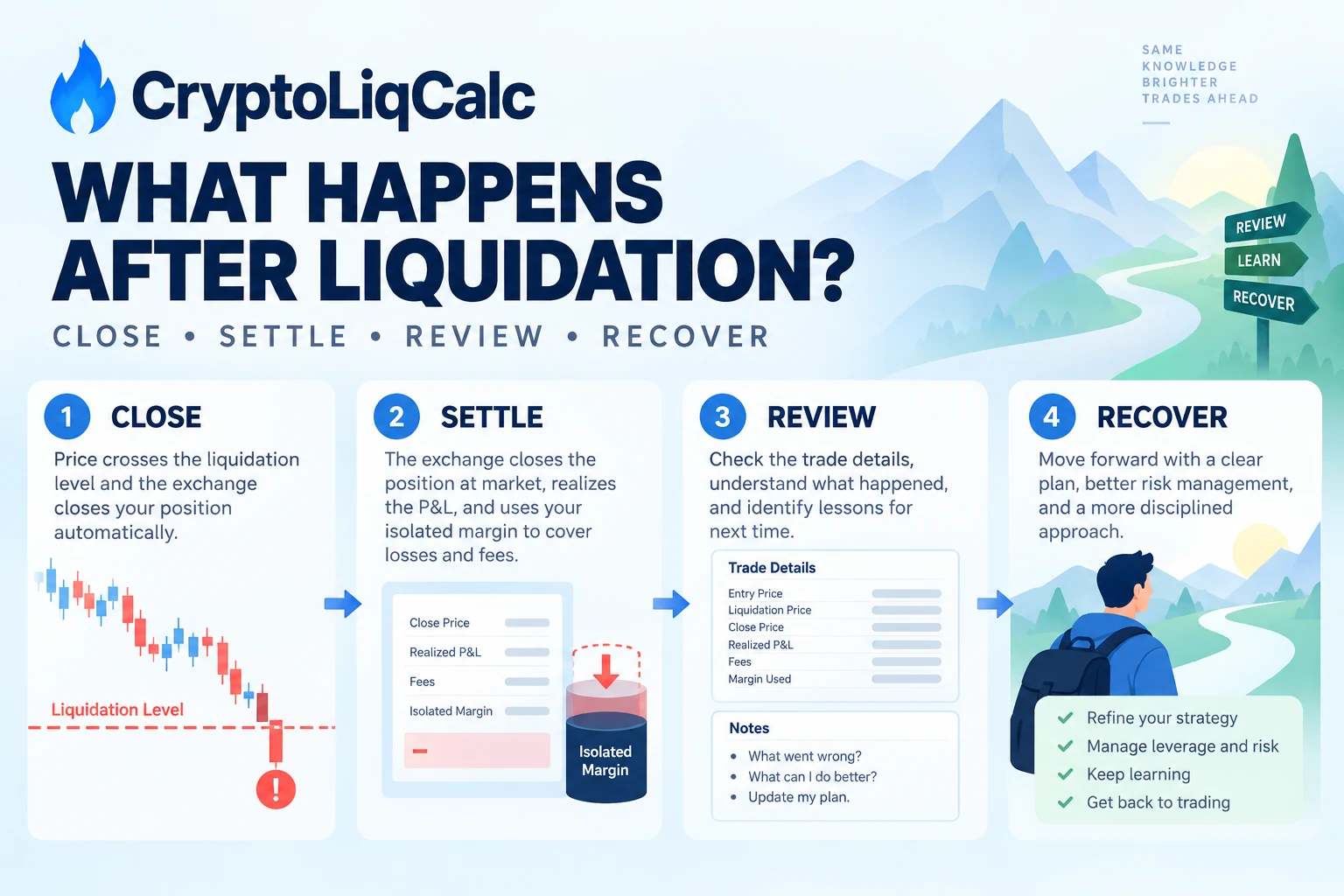
What actually happens the moment you're liquidated
When your position's losses reduce your margin down to the maintenance margin level, the exchange's liquidation engine automatically closes your position at (or near) the liquidation price — without asking for confirmation. This happens in milliseconds, faster than any manual reaction time.
Price reaches your liquidation level
The mark price (a smoothed average price used to prevent manipulation) touches your calculated liquidation price.
The exchange force-closes your position
Your position is closed automatically, often handed to the exchange's liquidation engine or an insurance fund to unwind.
Your margin for that position is gone
The margin allocated to the trade is used to cover the loss. What (if anything) remains above the maintenance margin is typically also consumed by liquidation fees.
You receive a notification
Most exchanges send an app/email notification confirming the liquidation, along with the closing price and remaining balance.
Do you owe money after liquidation?
On isolated margin: no. Your maximum loss is capped at the margin you allocated to that specific position. Once it's gone, the position closes and the rest of your account balance is untouched.
On cross margin: usually no, but not always guaranteed. Since your entire account balance backs the position, in extremely fast-moving markets (a "flash crash") it's theoretically possible for losses to exceed your balance before the exchange can close the position. This is rare on major exchanges because of the insurance fund mechanism explained below.
The insurance fund — how exchanges prevent negative balances
Major exchanges (Binance, Bybit, OKX, and others) maintain an insurance fund — a pool of capital built from liquidation fees over time. When a liquidation can't be closed exactly at the calculated liquidation price (due to a large position or fast market move), the insurance fund covers the gap so other traders and the exchange itself don't absorb the loss, and so liquidated traders rarely end up with a negative balance.
You can typically view an exchange's insurance fund size and history publicly on their website — it's a useful signal of exchange financial health.
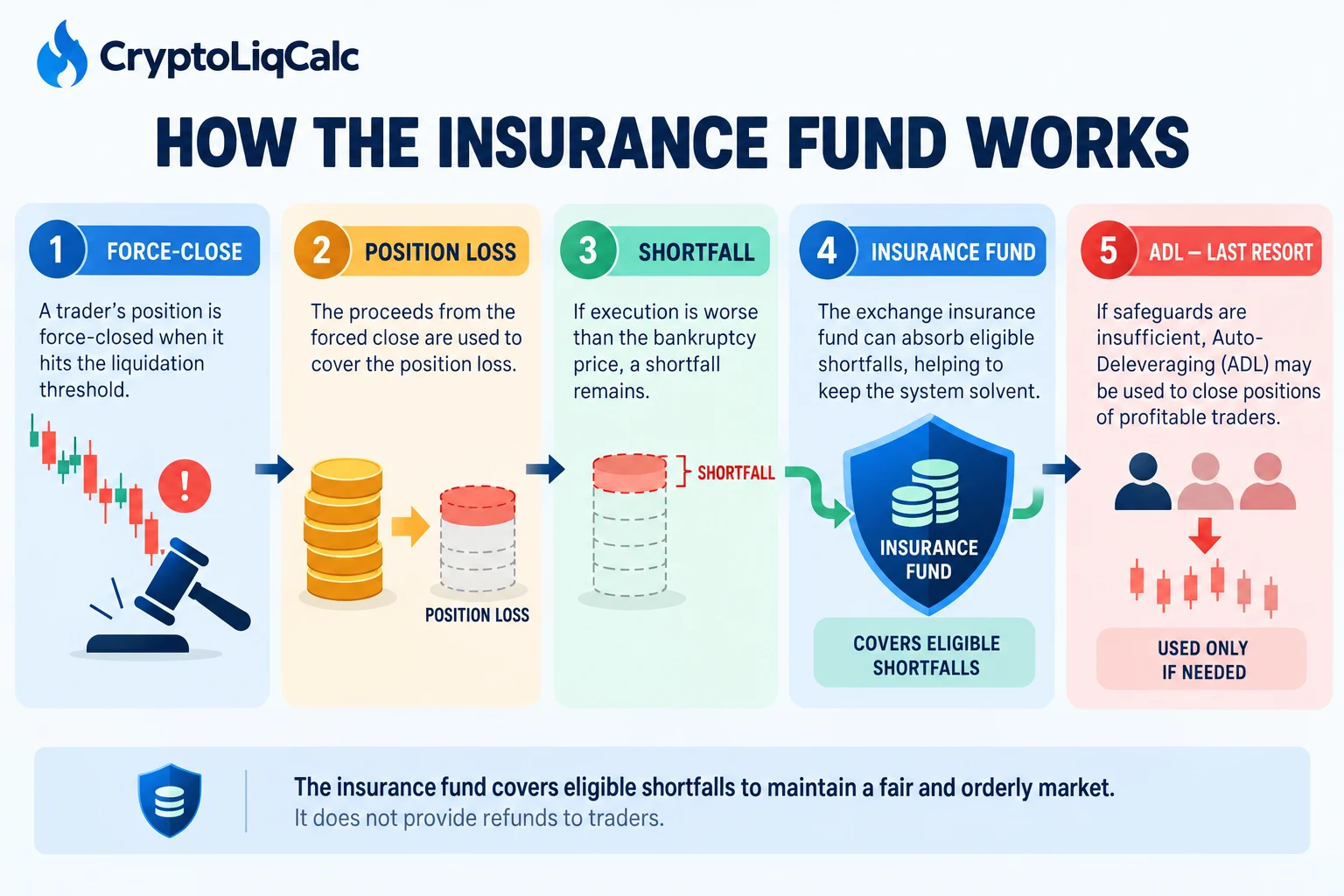
Insurance funds cover eligible execution shortfalls in the liquidation system. They do not refund the trader's lost margin. If safeguards are insufficient, an exchange may use auto-deleveraging under its own rules.
What exactly you lose
- The margin allocated to that position — the core loss
- A liquidation fee — most exchanges charge an additional fee (often similar to the taker fee) on the forced close, on top of your margin loss
- Unrealized profit from the same position, if the price had briefly moved in your favor before reversing
You do not lose funds in other open positions or your spot wallet, provided you were on isolated margin.
Does it affect your account or credit?
No. Liquidation is entirely contained within your exchange trading account. It does not:
- Affect your credit score
- Get reported to any credit bureau or financial institution
- Affect your bank accounts or other exchanges
- Prevent you from opening new positions immediately after (assuming you have remaining balance)
The consequence is purely financial — the lost margin — and psychological, which is often the harder part to manage.
How to recover and trade again
- Review what happened. Was your position size too large? Leverage too high? Stop loss too wide or missing? Use the Position Size Calculator to see what a correctly-sized version of that trade would have looked like.
- Recalculate before your next trade. Run your setup through the Liquidation Calculator before entering, not after.
- Reduce leverage. If you were liquidated at 20x+, consider trading the same setups at 5x–10x going forward.
- Set a stop loss before liquidation, every time. Verify your stop loss price sits between entry and liquidation — the calculator flags this automatically.
How to prevent it next time
- Always calculate your liquidation price before entering a trade, not after
- Keep your stop loss meaningfully closer to entry than your liquidation price — at least a 1–2% buffer
- Use isolated margin so your maximum loss is always known in advance
- Risk no more than 1–2% of your account per trade using proper position sizing
- Avoid holding highly leveraged positions through major news events or low-liquidity hours
Frequently asked questions
On isolated margin, no — you only lose the margin allocated to that position. On cross margin, a negative balance is possible in extreme volatility, though exchange insurance funds are specifically designed to prevent this in most cases.
No. Once a position is liquidated, the allocated margin is gone. There is no refund or reversal process for a standard liquidation.
No. Crypto futures liquidation is entirely contained to your exchange trading account and has no connection to your credit score, bank accounts, or any other financial record.