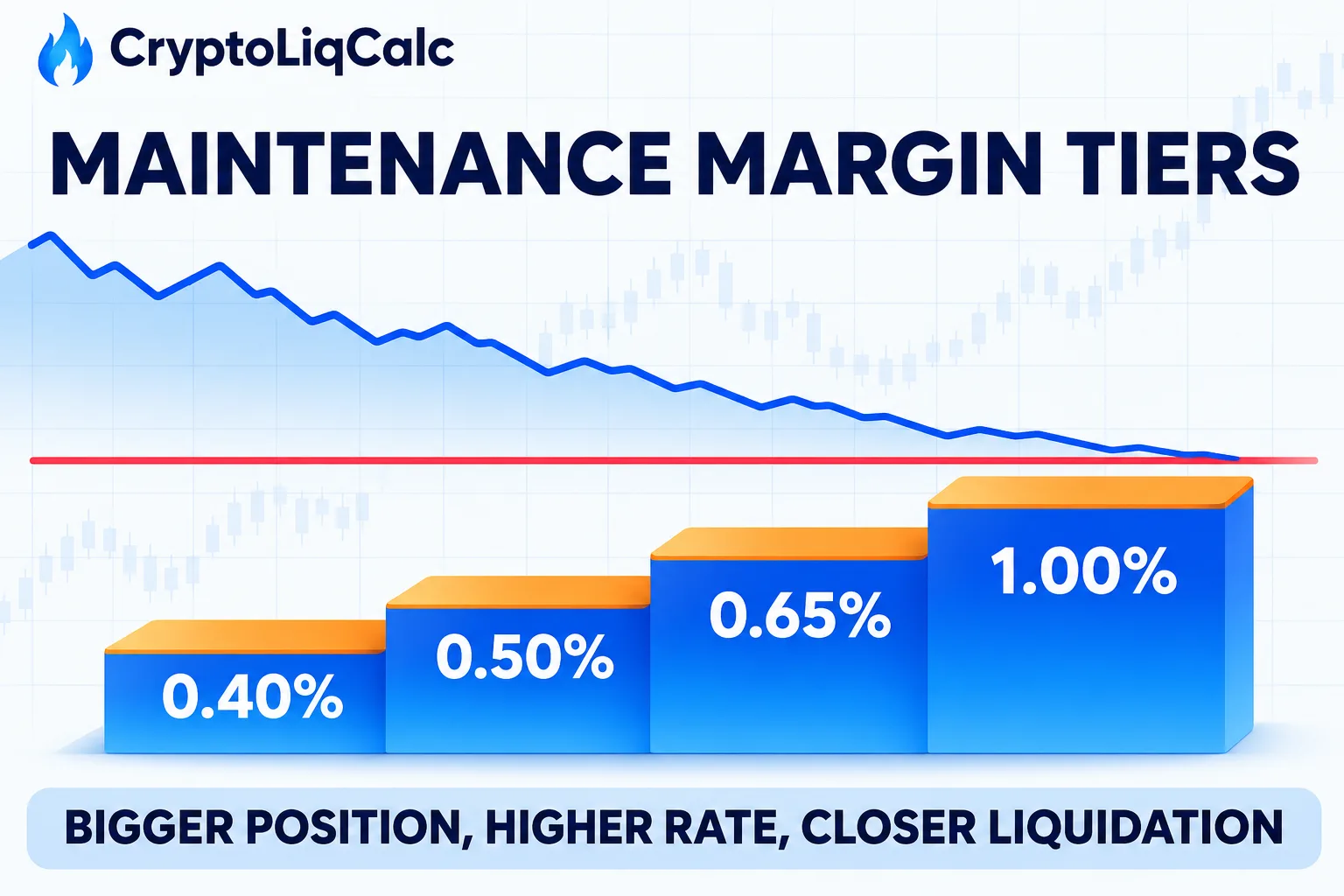
Most liquidation examples use one flat maintenance margin rate, such as 0.4%. Real exchanges do not. The rate you must keep as a safety margin rises in steps as your position grows, and the maximum leverage you may use falls with it. Here is what the tiers are, how they change your liquidation price, and why the effect is small for most traders but large at size.
- Maintenance margin is not a flat rate. It rises in tiers as position value grows.
- A maintenance deduction keeps the change smooth, so there is no cliff at a tier edge.
- At 10x the tiers move liquidation by a fraction of a percent. At 50x and $12 million, the room to liquidation falls from 1.61% to 1.11%.
- Max leverage falls as you enter higher tiers, so the leverage you planned may not be available.
What a maintenance margin tier is
Maintenance margin is the minimum margin an exchange requires you to keep so a position stays open. If your margin falls to that level, the position is liquidated. Exchanges set it as a percentage of the position value, and they set a higher percentage for bigger positions because a large liquidation is harder to close without moving the market.
That gives a table of tiers. Each tier covers a band of position value and carries its own rate and its own maximum leverage. Here are the first tiers for BTC/USDT perpetual futures on Binance, as used by our calculator:
| Position value up to | Maintenance rate | Max leverage | Maintenance deduction |
|---|---|---|---|
| $300,000 | 0.40% | 150x | $0 |
| $800,000 | 0.50% | 100x | $300 |
| $3,000,000 | 0.65% | 75x | $1,500 |
| $12,000,000 | 1.00% | 50x | $12,000 |
| $70,000,000 | 2.00% | 25x | $132,000 |
Position value is the notional size, which is your margin multiplied by your leverage. A $10,000 margin at 10x is a $100,000 position, so it sits in tier 1.
The maintenance margin formula and deduction
You might expect liquidation to jump the moment your position crosses $300,000 and the rate goes from 0.40% to 0.50%. It does not. Exchanges apply the new rate to the whole position and then subtract a fixed maintenance deduction, chosen so the required margin is the same on either side of the boundary.
The required maintenance margin is: position value × tier rate − deduction. For a $1,000,000 BTC position on Binance (tier 3), that is $1,000,000 × 0.65% − $1,500 = $5,000, which is an effective rate of 0.50%. The rate printed on the tier is not the rate you effectively pay; the effective rate sits between the tier’s own rate and the previous one.
You can see the smooth step in the numbers. At 10x from $65,000, a $300,000 position liquidates at $58,735, and a $300,010 position, which is in tier 2, liquidates at $58,729. A six-dollar change, not a cliff.
How tiers move your liquidation price
Using the standard isolated-margin formula with the tier’s deduction, here is a BTC long from $65,000 at 10x leverage on Binance, at four position sizes:
| Position value | Tier | Effective rate | Liquidation price | Room from entry |
|---|---|---|---|---|
| $100,000 | 1 | 0.40% | $58,735 | 9.64% |
| $1,000,000 | 3 | 0.50% | $58,785 | 9.56% |
| $3,000,000 | 3 | 0.60% | $58,850 | 9.46% |
| $12,000,000 | 4 | 0.90% | $59,025 | 9.19% |
Going from $100,000 to $12 million moves liquidation from $58,735 to $59,025, so the room to liquidation shrinks from 9.64% to 9.19%. For a short, the same effect works the other way: the 10x short from $65,000 liquidates at $71,215 at $100,000 and at $71,135 at $1,000,000. At 10x, the tiers matter less than your leverage choice. Compare that with the 5x to 50x spread in how liquidation price is calculated.
Higher leverage makes tiers matter more
The same tier change costs more when your buffer is thin. At 50x, the room to liquidation is already only 1.61%, and each step up takes a visible bite:
| Position value | Tier | Effective rate | Liquidation price | Room from entry |
|---|---|---|---|---|
| $300,000 | 1 | 0.40% | $63,956 | 1.61% |
| $3,000,000 | 3 | 0.60% | $64,084 | 1.41% |
| $12,000,000 | 4 | 0.90% | $64,278 | 1.11% |
At $12 million the room has fallen from 1.61% to 1.11%, a loss of about a third. The maintenance rate matters more as the leverage rises because liquidation is closer to entry, where a few tenths of a percent of position value is a large share of your margin.
Max leverage falls with size
The other effect is easy to miss. Each tier caps leverage, so the leverage you used on a small position may be refused on a large one. On Binance BTC/USDT:
- Up to $300,000: up to 150x.
- Up to $800,000: up to 100x.
- Up to $3,000,000: up to 75x.
- Up to $12,000,000: up to 50x.
If you scale a position up and find the exchange lowering your leverage, you have moved into a higher tier. The margin you need is the larger position value divided by the lower leverage, so scaling up costs more margin than the simple ratio suggests.
Tiers differ by exchange and coin
Every exchange publishes its own tiers. For the same $1,000,000 BTC long at 10x from $65,000, our calculator gives:
| Exchange | Tier | Rate | Effective rate | Liquidation price | Room from entry |
|---|---|---|---|---|---|
| Binance | 3 | 0.65% | 0.50% | $58,785 | 9.56% |
| Bybit | 2 | 0.50% | 0.45% | $58,761 | 9.60% |
| Bitget | 2 | 0.50% | 0.48% | $58,781 | 9.57% |
| MEXC | 2 | 0.40% | 0.17% | $58,582 | 9.87% |
The spread is small, about $200 on a $65,000 entry, but it shows that two exchanges disagree on the same trade. MEXC’s low effective rate comes from its own tier structure, which it publishes in contracts, and we convert it at the entry price. Treat our figures as estimates and compare them with the exchange’s own liquidation price.
Tiers also vary by coin. On Binance the first-tier rate is 0.40% for BTC and ETH, 0.50% for SOL and XRP, 0.65% for DOGE and 1.00% for SUI, so an altcoin trade starts with a thinner buffer than BTC at the same leverage. Our calculator applies the exchange’s tier automatically for Binance (BTC and 14 other pairs), Bybit, Bitget and MEXC (BTC). OKX is not modelled, so enter its rate by hand under advanced settings.
Choose your exchange, enter margin and leverage, and the calculator applies the tier for your position value.
Open Liquidation CalculatorWhat to do about it
- Work out your position value (margin × leverage), not just your margin, and find its tier on your exchange.
- Check the maximum leverage for that tier before you size the trade.
- Recalculate when you add to a position. A larger position can move you up a tier and pull liquidation closer.
- Compare our estimate with the exchange’s own liquidation price. Tiers change, VIP levels differ, and fees and funding are not included here.
- Keep a stop loss well inside the liquidation price, as explained in how to size a position.