How to Calculate Liquidation Price: The Formula, Step by Step
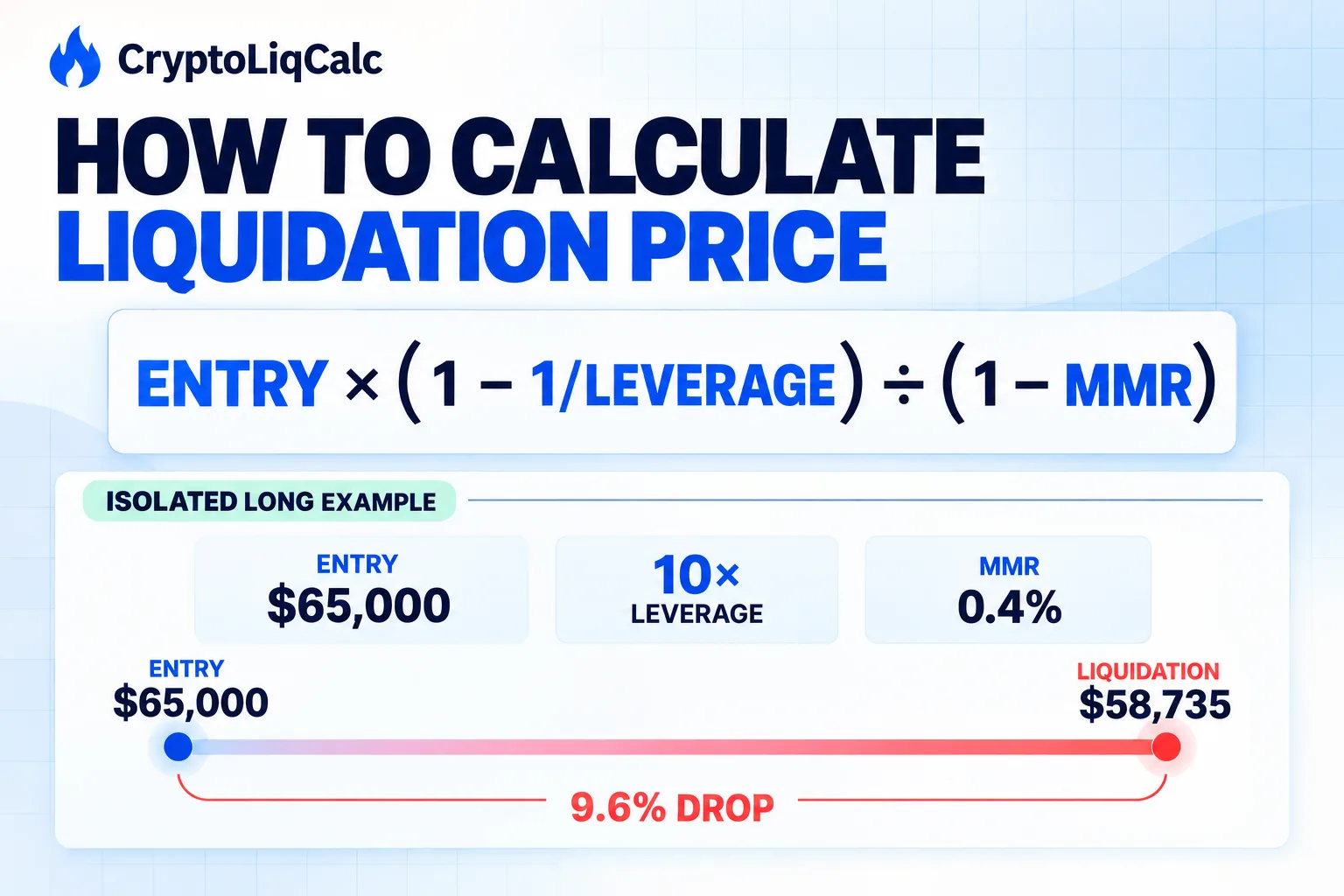
Your liquidation price is the number that decides how much room a leveraged trade has. The core calculation is short enough to do by hand, and doing it once makes every calculator, and every exchange warning, easier to read.
- For an isolated long:
Entry × (1 − 1/Leverage) ÷ (1 − MMR). For a short:Entry × (1 + 1/Leverage) ÷ (1 + MMR). - The distance to liquidation is roughly
1/Leverage − MMR, so 10x leaves about 9.6% and 20x about 4.6% at a 0.4% rate. - It is a planning estimate. Fees, funding and mark price move the real number, and larger positions fall into higher maintenance tiers.
- Always confirm the figure on your exchange, then check your stop sits before it.
What liquidation price actually is
When you open a leveraged position, your margin pays for only part of it. If the market moves against you far enough that your remaining margin falls to the exchange's maintenance margin requirement, the exchange closes the position. The price where that happens is the liquidation price.
Three inputs drive it: your entry price, your leverage, and the maintenance margin rate (MMR), the percentage of position value the exchange requires you to keep as a buffer.
The liquidation price formula
For an isolated-margin position on a USDT-margined contract, the exchange-style form (before fees and funding) is:
The 1/Leverage term is the share of the position your margin covers. Dividing by 1 − MMR (or 1 + MMR for a short) reflects that the exchange requires its maintenance margin on the position's value at the liquidation price, which is why liquidation happens slightly before your margin is completely gone.
Worked example: a long
You buy BTC at $65,000 with 10x leverage and a 0.4% MMR.
- Leverage term: 1 ÷ 10 = 0.10, so 1 − 0.10 = 0.90
- MMR as a decimal: 0.4% = 0.004, so 1 − 0.004 = 0.996
- Factor: 0.90 ÷ 0.996 ≈ 0.9036
- Liquidation price: $65,000 × 0.9036 ≈ $58,735
That is a 9.6% drop from entry. Any stop loss you want to rely on has to sit between $65,000 and $58,735.
Worked example: a short
Same trade, opposite direction. For a short, price rising is what hurts:
$65,000 × (1 + 0.10) ÷ (1 + 0.004) = $65,000 × 1.0956 ≈ $71,215, a 9.6% rise from entry.
How leverage moves the price
Holding entry at $65,000 and MMR at 0.4%, here is the isolated long liquidation price at different leverage:
| Leverage | Liquidation (long) | Drop from entry |
|---|---|---|
| 2x | $32,631 | 49.8% |
| 5x | $52,209 | 19.7% |
| 10x | $58,735 | 9.6% |
| 20x | $61,998 | 4.6% |
| 50x | $63,956 | 1.6% |
The relationship is not gentle. Going from 10x to 20x halves your room, and at 50x a move of under 2% ends the trade. You can check any row yourself in the Liquidation Calculator.
What this formula still leaves out
The formula above matches how exchanges treat an isolated linear position before fees, but real accounts add more:
- Maintenance margin tiers. The rate rises as position size grows, and most exchanges subtract a tier-specific maintenance amount, which pulls liquidation closer for big positions. Our calculator applies the published tiers for Bybit, Bitget and MEXC.
- Mark price. Liquidation commonly uses mark price, not last price. See why you can be liquidated before your stop.
- Fees and funding. Both reduce margin over time. See how funding raises liquidation risk.
- Cross margin. Wallet balance and other positions also back the trade, so the result depends on your whole account. See isolated vs cross margin.
How to check your number
- Calculate it by hand or with the calculator using your exchange's MMR for your position size.
- Open the position on your exchange and compare its displayed liquidation price. Small differences are normal.
- If the gap is large, look for a higher MMR tier, extra fees or a different margin mode.
- Place your stop loss before the liquidation price with room for slippage, then recheck after adding margin or changing size.
FAQ
Sources
- Binance Futures documentation (liquidation and margin mechanics)
- Bybit Help Center (liquidation price and maintenance margin)