5 Mistakes That Get Leveraged Traders Liquidated (Beyond "Too Much Leverage")
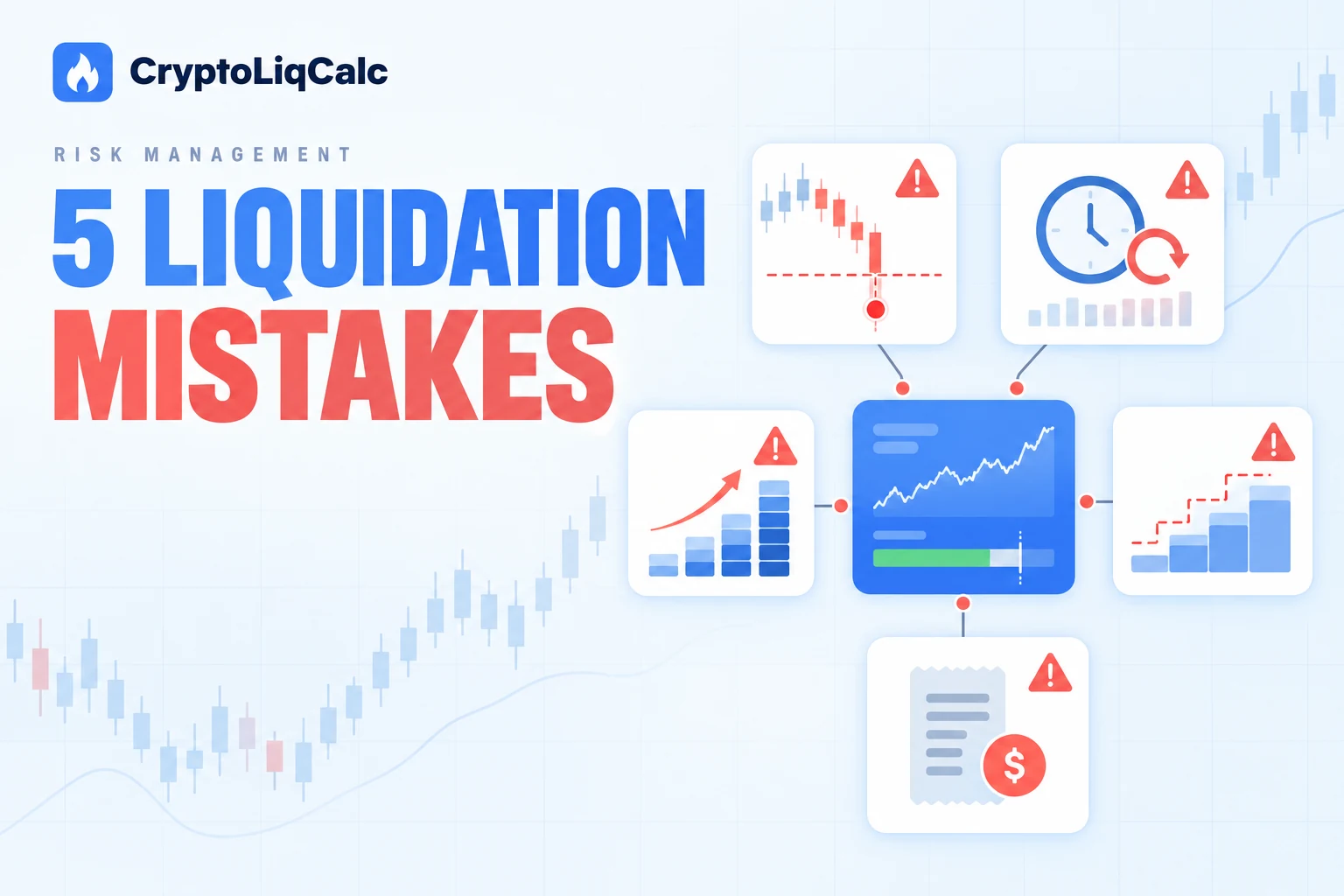
"Don't use too much leverage" is true and unhelpful — everyone already knows it. The traders who get liquidated on reasonable leverage usually make one of these five mistakes instead, all of which are mechanical, not psychological.
- Most liquidations at reasonable leverage come from mechanical mistakes, not just leverage size.
- A stop loss set past your liquidation price will never trigger — the exchange liquidates you first.
- Maintenance margin rates rise in tiers as position size grows, quietly moving your real liquidation price closer to entry.
- Every time you add margin to a position, recalculate — don't trust your last liquidation price after the trade has changed.
1 Setting a stop loss past the liquidation price
A stop loss only protects you if it triggers before the exchange liquidates you. If your stop loss is set at a price the market reaches only after your liquidation price has already been hit, the stop loss never fires — you're liquidated first, at a worse price than your intended stop, and you lose your full margin instead of the smaller loss you planned for.
Why this happens
Traders often set stop losses based on a technical level (a support/resistance line) without checking where that level sits relative to their liquidation price at their chosen leverage. At high leverage, the liquidation price can be closer to entry than the technical level they were planning to use.
2 Ignoring maintenance margin rate tiers
Maintenance margin rate (MMR) isn't a flat percentage — it increases in tiers as your position size grows. A $5,000 position might sit in a 0.4% MMR tier, while a $500,000 position on the same asset could be in a 1% or higher tier. Traders who size up without checking the new tier underestimate how close their real liquidation price actually is.
3 Not accounting for funding rate drag on multi-day holds
A liquidation price calculated at entry assumes your margin balance stays constant. On a position held for days through periodic funding payments, that assumption breaks — funding is deducted directly from your margin, meaning your real liquidation price creeps closer to your entry price the longer you hold, even with the market price unchanged.
4 Using cross margin as a default, not a decision
Cross margin pools your entire account balance behind every open position. Traders often switch to it because the liquidation price "looks safer" (it's further from entry), without registering that they've also just exposed their full account balance to that one trade — including balance that was meant to back other, unrelated positions.
5 Averaging down into a losing position without recalculating
Adding margin to a losing position (to "give it more room") changes your liquidation price and your effective entry price — but many traders add margin reactively, under stress, without recalculating either number. The result is a position whose actual risk profile they no longer understand, sized larger than they originally intended, still moving against them.
Why this compounds
Each addition changes both the average entry price and the margin base the liquidation formula uses. Without recalculating after every addition, a trader can end up meaningfully closer to liquidation than they believe — precisely because they keep intervening without re-measuring where they actually stand.
Conclusion
None of these five mistakes require careless trading — they're the kind of thing that slips through even when you're being careful, because each one only shows up as a number you didn't recalculate. The fix in every case is the same habit: run your actual current numbers through a liquidation calculator before you rely on them, not just once at entry.
FAQ
Sources
- Binance Futures documentation — tiered maintenance margin rate tables
- Bybit Help Center — margin and liquidation mechanics